
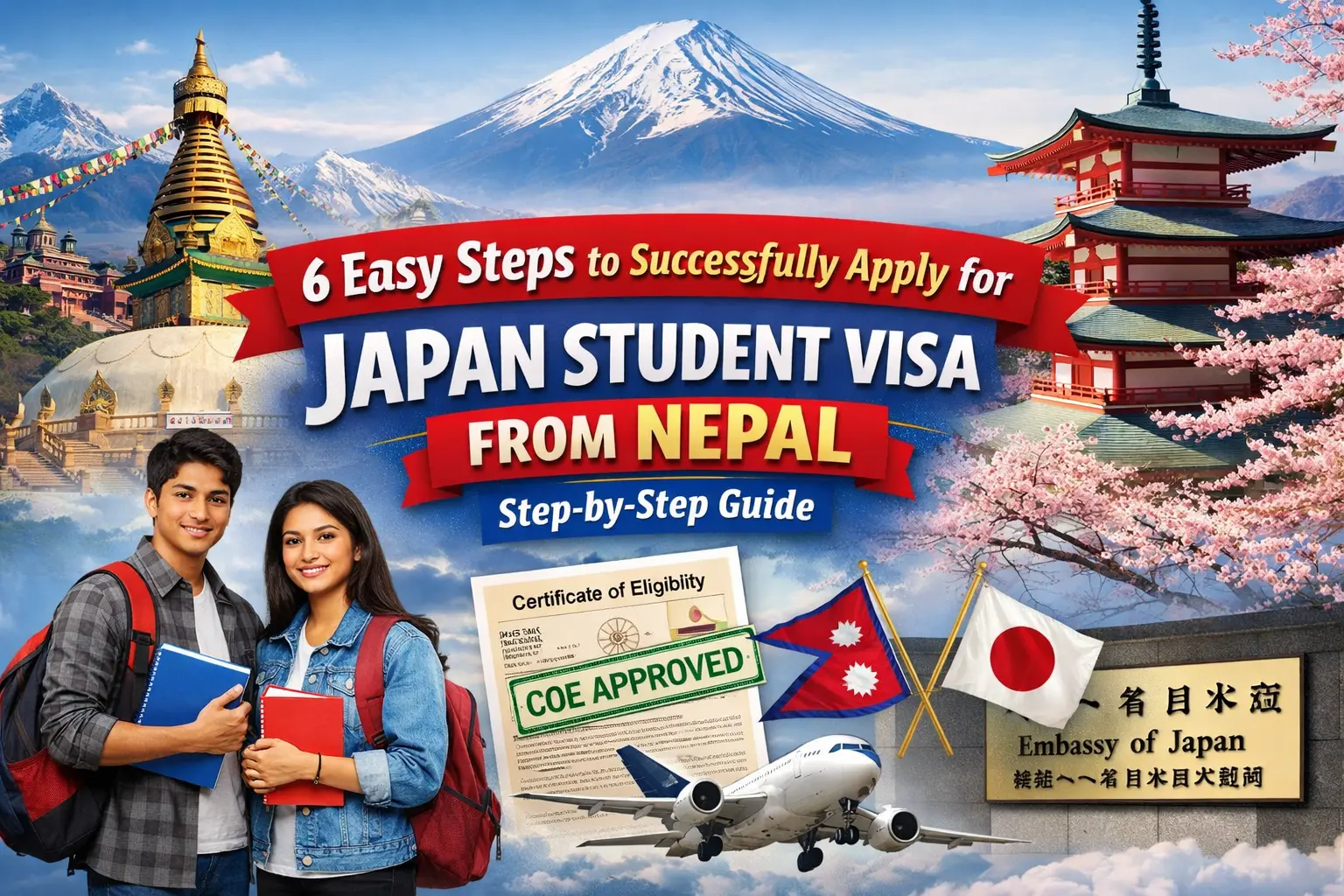
Dreaming of studying in Japan? The journey starts with your student visa application. Japan has become one of the most sought-after destinations for Nepali students, offering world-class education, cutting-edge technology programs, and excellent career opportunities. What makes Japan even more attractive is the chance to work part-time while studying, allowing you to support yourself financially and gain valuable work experience in one of the world’s most advanced economies.
However, many students feel overwhelmed by the visa application process. If you’re wondering how to apply for a Japan student visa from Nepal, you’re in the right place. The process involves multiple steps, strict documentation requirements, and can take 6-8 months from start to finish. But don’t worry – with proper guidance and preparation, getting your Japan student visa is absolutely achievable.
In this comprehensive guide, we’ll walk you through every single step of the application process, from choosing your school to landing in Japan. You’ll learn about eligibility requirements, essential documents, the Certificate of Eligibility (COE) process, timeline expectations, costs involved, and insider tips to avoid common rejection reasons.
At Sitasmi Global Education, we’ve successfully helped over 50 students obtain their Japan student visa, and we understand exactly what immigration authorities look for in applications. We’ve compiled all our expertise into this guide to help you succeed.
By the end of this article, you’ll have a clear roadmap for your Japan student visa application and the confidence to navigate the process successfully. Let’s get started!
Types of Student Visas for Japan
Before starting your application, it’s important to understand which type of student visa you need. Japan offers different visa categories depending on your study goals, and choosing the right one is the first step toward a successful application.
Student Visa (留学 – Ryugaku): The Main Visa Category
The Student Visa, known as Ryugaku (留学) in Japanese, is the most common visa for international students from Nepal. This visa covers both degree programs and language school studies.
For Degree Programs: If you’re planning to pursue higher education in Japan, the Student Visa is what you need. This applies to:
- Undergraduate programs (Bachelor’s degree – typically 4 years)
- Graduate programs (Master’s degree – typically 2 years)
- Doctoral programs (PhD – typically 3-5 years)
The visa duration is initially granted for 1-2 years and can be renewed as long as you maintain good academic standing and attendance.
For Language Schools: If you’re enrolling in a Japanese language school (日本語学校), you’ll also apply for a Student Visa. Language school programs typically run from 6 months to 2 years. Many students start with language school to improve their Japanese before entering university programs.
Work Permission: One of the biggest advantages of a Student Visa is the ability to work part-time in Japan:
- During semester: Up to 28 hours per week
- During holidays: Full-time work allowed (approximately 40 hours per week)
This part-time work opportunity allows you to earn ¥100,000-140,000 per month, which can significantly help cover your living expenses. However, you must obtain “Permission to Engage in Activity Other Than Permitted” (資格外活動許可) from the Immigration Bureau.
Pre-College Student Visa
This visa category exists for students enrolled in preparatory or foundation courses before starting their main degree program. However, this is less commonly used, and most students apply directly for the standard Student Visa.
| Your Study Plan | Visa Type | Duration | Notes |
| Japanese Language School | Student Visa (Ryugaku) | 6 months – 2 years | Can transfer to university later |
| Undergraduate/Bachelor’s | Student Visa (Ryugaku) | 4 years (renewed periodically) | Part-time work allowed |
| Master’s Degree | Student Visa (Ryugaku) | 2 years (renewed periodically) | Research opportunities available |
| Doctoral/PhD Program | Student Visa (Ryugaku) | 3-5 years (renewed periodically) | May qualify for scholarships |
| Preparatory Course | Pre-College Student Visa | Varies | Less common option |
Ready to apply? Explore our Student Visa services, where we provide complete support from school selection to visa approval, with a proven track record of 50+ successful applications.
Step-by-Step Guide to Apply for Japan Student Visa from Nepal
Step 1: Choose Your School or University in Japan – Explained Simply
The first and most important step in applying for a Japan student visa is choosing a recognized educational institution in Japan. Only schools approved by the Japanese government are allowed to accept international students and sponsor student visas.
Types of Institutions You Can Choose From
Depending on your academic background and future goals, you can apply to one of the following:
- Japanese Language Schools
- Ideal for students who want to learn Japanese first
- Courses usually last from 6 months to 2 years
- Common choice for Nepali students planning to work or study further in Japan
- Universities or Graduate Schools
- For Bachelor’s, Master’s, or PhD programs
- Requires stronger academic records and often Japanese or English proficiency (JLPT, IELTS, or TOEFL)
- Vocational or Technical Institutes (Senmon Gakkō)
- Focus on practical skills such as IT, nursing, business, hospitality, or engineering
- Suitable for students seeking job-oriented education
How to Apply to a Japanese School
You can apply in two main ways:
- Direct Application:
Apply directly through the school’s official website by submitting required documents such as academic certificates, passport copy, and financial proof. - Through an Authorized Educational Consultancy:
Many Nepali students choose consultancies because they help with:- School selection
- Document preparation
- Application submission
- Visa guidance
What Happens After You Are Accepted?
Once the school accepts your application, they become your official sponsor. This means:
- The school applies for your Certificate of Eligibility (COE)
- The COE is required to apply for a Japan student visa
- Without school acceptance, you cannot apply for the visa
Why This Step Is Crucial
- The visa decision depends heavily on the school’s credibility
- Choosing the right institution increases your visa approval chances
- Your course should match your academic background and career goals
Step 2: Receive the Certificate of Eligibility (COE) – Explained Clearly
After you are accepted by a Japanese school, the next and most crucial step in the visa process is obtaining the Certificate of Eligibility (COE).
What Is the Certificate of Eligibility (COE)?
The Certificate of Eligibility (COE) is an official document issued by the Immigration Services Agency of Japan. It confirms that:
- You meet Japan’s immigration requirements
- Your purpose of stay (study) is genuine
- Your school and financial background have been verified
Without a COE, you cannot apply for a Japan student visa.
Who Applies for the COE?
- You do not apply for the COE yourself
- Your Japanese school applies on your behalf to the immigration office in Japan
To do this, the school will ask you to submit documents such as:
- Passport copy
- Academic certificates
- Financial documents
- Sponsor details
Once submitted, the school forwards everything to Japanese immigration.
Who Issues the COE?
- The COE is issued by the Immigration Services Agency of Japan
- Immigration officers carefully review:
- Your study plan
- Financial capacity
- Academic background
- School credibility
This step helps prevent visa misuse and ensures only genuine students are approved.
COE Processing Time
- Average processing time: 1 to 3 months
- It may take longer during peak intake seasons (April and October)
- Delays can occur if documents are incomplete or unclear
Because of this, students are advised to apply early.
What Happens After COE Approval?
- Once approved, the immigration office issues the original COE
- The school sends the COE to you in Nepal (by courier or scanned copy, depending on embassy rules)
- You will then use the COE to apply for your Japan student visa at the Embassy of Japan in Kathmandu
Why the COE Is So Important
- It greatly increases your visa approval chances
- It shortens embassy visa processing time
- It proves that Japanese immigration has already approved your stay
In summary, the COE is the foundation of your Japan student visa application. Once you receive it, you are one step away from getting your visa.
Step 3: Prepare Required Documents – Detailed Explanation
Once you receive the Certificate of Eligibility (COE), the next step is to prepare all the required documents for submitting your Japan student visa application at the Embassy of Japan in Nepal. Proper and complete documentation is extremely important, as missing or incorrect papers can delay or even reject your visa.
Below is a clear explanation of each required document:
1. Valid Passport (Minimum 6 Months Validity)
- Your passport must be original and valid for at least six months
- It should have blank pages for the visa stamp
- If your passport is close to expiry, renew it before applying
2. Japan Student Visa Application Form
- This is the official visa application form issued by the Embassy of Japan
- Must be filled clearly and correctly (no false information)
- Details should exactly match your passport and COE
- Sign the form where required
3. Recent Passport-Size Photographs
- Usually 2–4 recent photos
- White background, clear face, no shadows
- Photos should be taken within the last 6 months
- Follow the size guidelines given by the embassy
4. Original Certificate of Eligibility (COE)
- This is the most important document
- Issued by Japanese immigration
- Confirms your eligibility to stay in Japan as a student
- Must be submitted in original form (not photocopy unless allowed)
5. Admission Letter from Japanese Institution
- Issued by your Japanese school or university
- Confirms your acceptance into the course
- Includes course name, duration, and start date
- Proves the purpose of your stay in Japan
6. Academic Certificates and Transcripts
- Includes:
- SEE / SLC certificates
- +2 certificates and mark sheets
- Bachelor’s degree (if applying for Master’s)
- Shows your educational background
- Must be genuine and consistent with your study plan
7. Proof of Financial Ability
This proves that you (or your sponsor) can cover your expenses in Japan.
Common financial documents include:
- Bank balance certificate
- Bank statements (usually 6 months)
- Income source documents (salary slip, business registration, tax clearance)
- Sponsorship letter
Japanese immigration wants to ensure you can pay for:
- Tuition fees
- Living expenses
8. Relationship Certificate (If Sponsor Is a Parent or Relative)
- Required when your education is sponsored by:
- Father
- Mother
- Uncle, aunt, or close relative
- Confirms your relationship with the sponsor
- Usually issued by local government authorities in Nepal
9. Visa Fee Payment Receipt
- Proof that you have paid the required visa fee (if applicable)
- For Nepali students, Japan student visa fees are often free, but rules may change
- Always keep the receipt as evidence
Important Tips for Document Preparation
- All information must be true and consistent
- Arrange documents neatly in order
- Use clear photocopies where originals are not required
- Any fake or misleading document can lead to visa rejection
Summary
Preparing accurate and complete documents after receiving the COE is a key step in securing your Japan student visa. Strong documentation increases your chances of approval and ensures a smooth application process.
Step 4: Submit Visa Application at the Embassy of Japan in Nepal – Explained
After preparing all required documents, the next step is to submit your Japan student visa application. This step officially begins the visa assessment process.
Where to Submit the Application
You must submit your application at:
Embassy of Japan in Kathmandu, Nepal
This is the only authorized body in Nepal that processes Japan student visa applications.
How Applications Are Submitted
- In most cases, students cannot submit applications directly
- Applications are usually submitted through a designated visa agent or authorized educational consultancy
- These agents are approved by the Japanese Embassy to handle visa submissions
Your consultancy will:
- Check your documents
- Submit them on your behalf
- Inform you about collection dates or interviews
Personal Appearance (If Required)
- Some applicants may be asked to appear in person at the embassy
- This may be required for:
- Document verification
- Interview
- Biometric or identity confirmation
If you are called, you must attend on the given date and time with original documents.
After Submission of the Application
Once your application is successfully submitted:
- The embassy will issue an application receipt
- This receipt confirms that your documents are under review
- It is required later to:
- Track your application
- Collect your passport after a decision is made
Keep the receipt safe until the process is completed.
Important Things to Remember
- Ensure all documents are complete and accurate before submission
- Incomplete or incorrect documents may cause delays or rejection
- Follow instructions given by your consultancy or the embassy carefully
Summary
Submitting your visa application at the Embassy of Japan in Kathmandu is a critical step. Once submitted and accepted, your application enters the final review stage, bringing you closer to studying in Japan.
Step 5: Attend Interview (If Required) – Explained Simply
After submitting your visa application, some applicants may be called for an interview by the Embassy of Japan in Nepal. Not all students are interviewed, but if you are selected, this step is very important for your visa decision.
Why the Interview Is Conducted
The interview helps visa officers confirm that:
- You are a genuine student
- Your purpose of going to Japan is only for study
- Your documents and intentions are clear and truthful
It is a verification step, not something to fear.
Common Topics Asked in the Interview
- Your Study Plan in Japan
- Why did you choose Japan?
- Why this particular school or course?
- How does this course relate to your past education?
- Financial Background
- Who is sponsoring your education?
- What is your sponsor’s occupation and income source?
- Can you cover tuition and living expenses in Japan?
- Japanese Language Ability (Basic Level)
- Simple self-introduction in Japanese
- Basic greetings or daily conversation
- Even beginner-level knowledge is acceptable for language students
- Future Goals After Graduation
- What are your plans after completing your studies?
- Do you plan to return to Nepal or use your education for career growth?
- Clear future goals show strong intent
How to Answer in the Interview
- Answer honestly — never give false information
- Be confident and calm
- Keep answers clear and simple
- Make sure your answers match your documents and study plan
Important Tips for Interview Success
- Review your application and documents beforehand
- Practice basic Japanese phrases
- Dress neatly and professionally
- Do not memorize answers like a script
Summary
The interview is a chance to show that you are a serious and genuine student. If you explain your study plan, financial situation, and future goals clearly and confidently, your chances of visa approval are very high.
Step 6: Visa Approval and Passport Collection – Explained Clearly
This is the final step in the Japan student visa process. After completing all previous steps and (if required) attending the interview, the Embassy of Japan will make a decision on your visa application.
Visa Processing Time
- The usual processing time is 5–10 working days
- This time period starts after submission of your COE and complete documents
- Processing may take longer during peak intake seasons or if additional verification is needed
During this period, the embassy carefully reviews your application.
Visa Approval
If your application is approved:
- Your Japan student visa will be stamped in your passport
- The visa will mention:
- Visa type (Student)
- Validity period
- Number of entries
This visa allows you to legally enter Japan for study purposes.
Passport Collection
- You (or your authorized agent/consultancy) will be informed when your passport is ready
- Bring your application receipt to collect the passport
- Always check:
- Your name
- Passport number
- Visa validity dates
Report any errors immediately.
After Receiving Your Visa
Once you receive your passport with the visa:
- Book your flight to Japan
- Inform your school about your arrival date
- Arrange accommodation (dormitory or apartment)
- Prepare required documents for immigration at the airport
Summary
Visa approval means you have successfully completed the Japan student visa process. With your visa stamped, you are now ready to begin your educational journey in Japan. Careful planning at this stage will ensure a smooth departure and arrival.
Final Thoughts
Applying for a Japan student visa from Nepal is a structured and achievable process if done correctly. With proper planning, accurate documentation, and a genuine study purpose, Nepali students have a high success rate.
Japan offers not just quality education but also valuable life experiences and global exposure. If studying in Japan is your goal, start your preparation early and follow each step carefully.
Q1: What is a Japan Student Visa for Nepali students?
A: A Japan Student Visa allows Nepali students to legally study in Japan for programs ranging from 6 months to several years, including Japanese language schools, universities, and vocational or technical colleges. To obtain this visa, you first need a Certificate of Eligibility (COE) issued by your Japanese school, which confirms that you meet Japan’s immigration and study requirements. After receiving the COE, you can apply for the student visa at the Embassy of Japan in Kathmandu. This visa also allows eligible students to work part-time during their studies, helping them gain valuable experience and support living expenses in Japan.
Q2: How can I apply for a Japan Student Visa from Nepal?
A: To apply for a Japan Student Visa from Nepal, you first need to secure admission at a recognized Japanese school, university, or vocational institute. Once accepted, your school will apply for a Certificate of Eligibility (COE) on your behalf, confirming that you meet Japan’s immigration and study requirements. After receiving the COE, you can submit your visa application—including your passport, visa application form, photos, and the COE—to the Embassy of Japan in Kathmandu or through authorized visa agents like VFS Global. Visa processing typically takes 5–10 working days, depending on the season.
Q3: What is a Certificate of Eligibility (COE) and why is it important?
A: A Certificate of Eligibility (COE) is an official document issued by the Immigration Services Agency of Japan that confirms a foreign student meets all legal requirements to study in Japan. For Nepali students, the COE is issued through the Japanese school or university that accepts you and it is a prerequisite for applying for a student visa. Having a COE significantly speeds up the visa process at the Embassy of Japan in Kathmandu and ensures smoother entry at Japanese immigration, proving that your purpose of stay—study—is genuine and approved by the authorities.


Leave a Reply